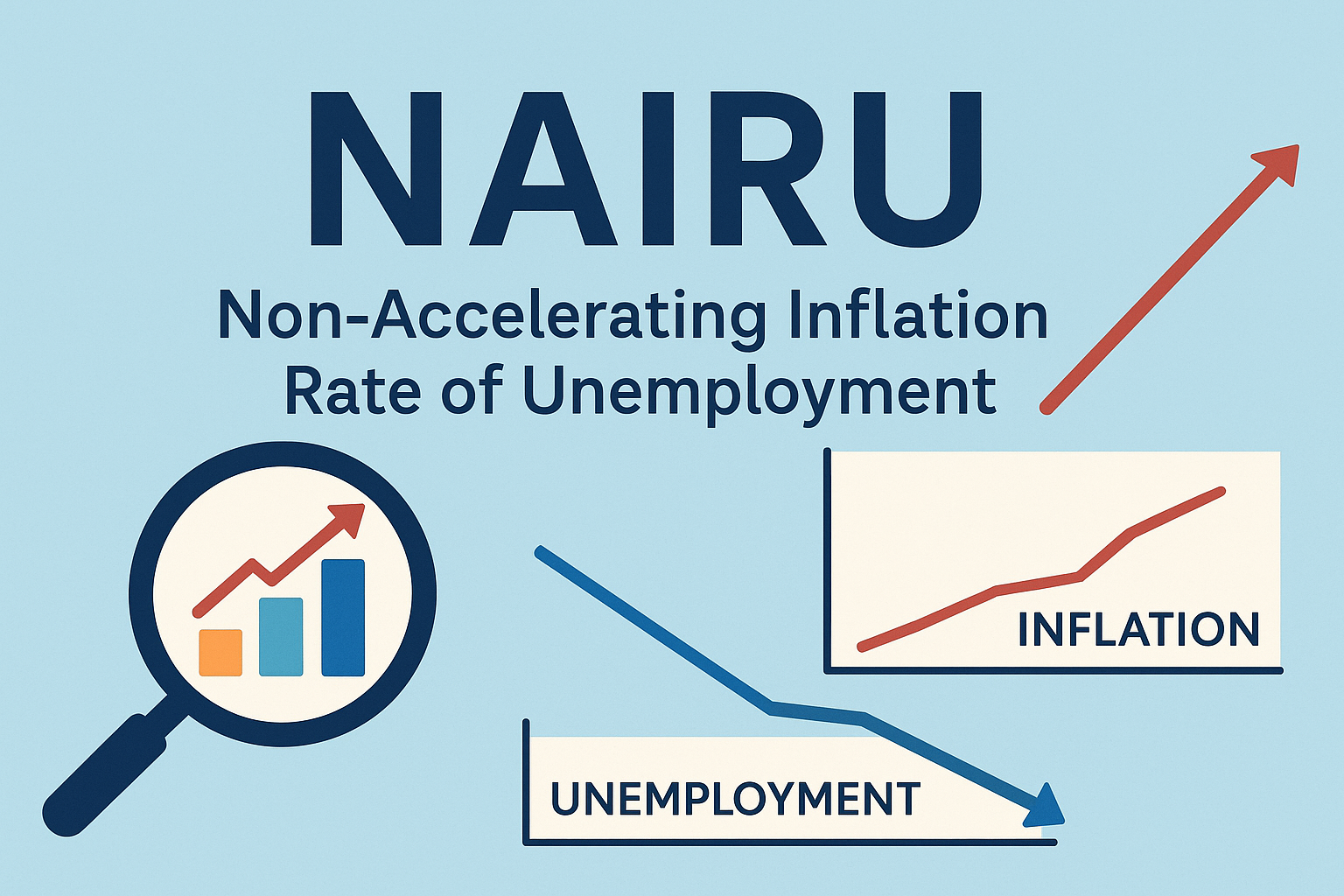
NAIRU, or the Non-Accelerating Inflation Rate of Unemployment, is an economic concept that represents the specific unemployment rate at which inflation remains stable, neither accelerating nor decelerating.
It is a theoretical benchmark where the labor market is in equilibrium, meaning there is neither upward pressure on wages (which fuels inflation) nor downward pressure (which could lead to deflation). NAIRU is closely tied to the idea of the "natural rate of unemployment," but it specifically focuses on the point where inflation is steady.
At NAIRU, which means that at a given rate of unemployment, the labor market has enough space to accomodate more people which prevents excessive wage growth that would drive inflation. Also unemployment is not so high as to create deflationary pressures from reduced consumer spending. Therefore at NAIRU, the economy is operating at a sustainable level without overheating or underperforming. At NAIRU: The economy is in a "Goldilocks" state—unemployment is just right to keep inflation stable, with wages growing in line with productivity and inflation expectations.
Below NAIRU: When unemployment is lower than NAIRU, the labor market becomes tight. Employers compete for fewer workers, driving up wages. Higher wages increase production costs, which businesses pass on to consumers, leading to higher inflation (demand-pull or cost-push inflation).
Above NAIRU: When unemployment exceeds NAIRU, there is excess labor supply. This reduces wage growth, lowers consumer spending, and puts downward pressure on prices, potentially leading to deflation or disinflation.
Demographics: Aging populations or changes in workforce participation (e.g., more women or young workers entering the labor force) can affect NAIRU. For instance, an aging workforce may lower NAIRU due to reduced labor supply.
Labor Market Policies: Minimum wage laws, union strength, or unemployment benefits can influence wage bargaining power and thus NAIRU.
Productivity: Higher productivity growth can reduce NAIRU by allowing wages to rise without increasing unit labor costs.
Globalization and Technology: Automation or global labor competition can alter structural unemployment, impacting NAIRU.
Economic Shocks: Events like oil price spikes (e.g., the Iran-Israel conflict mentioned in your referenced articles) can raise production costs, potentially pushing NAIRU higher as inflation rises independently of unemployment.

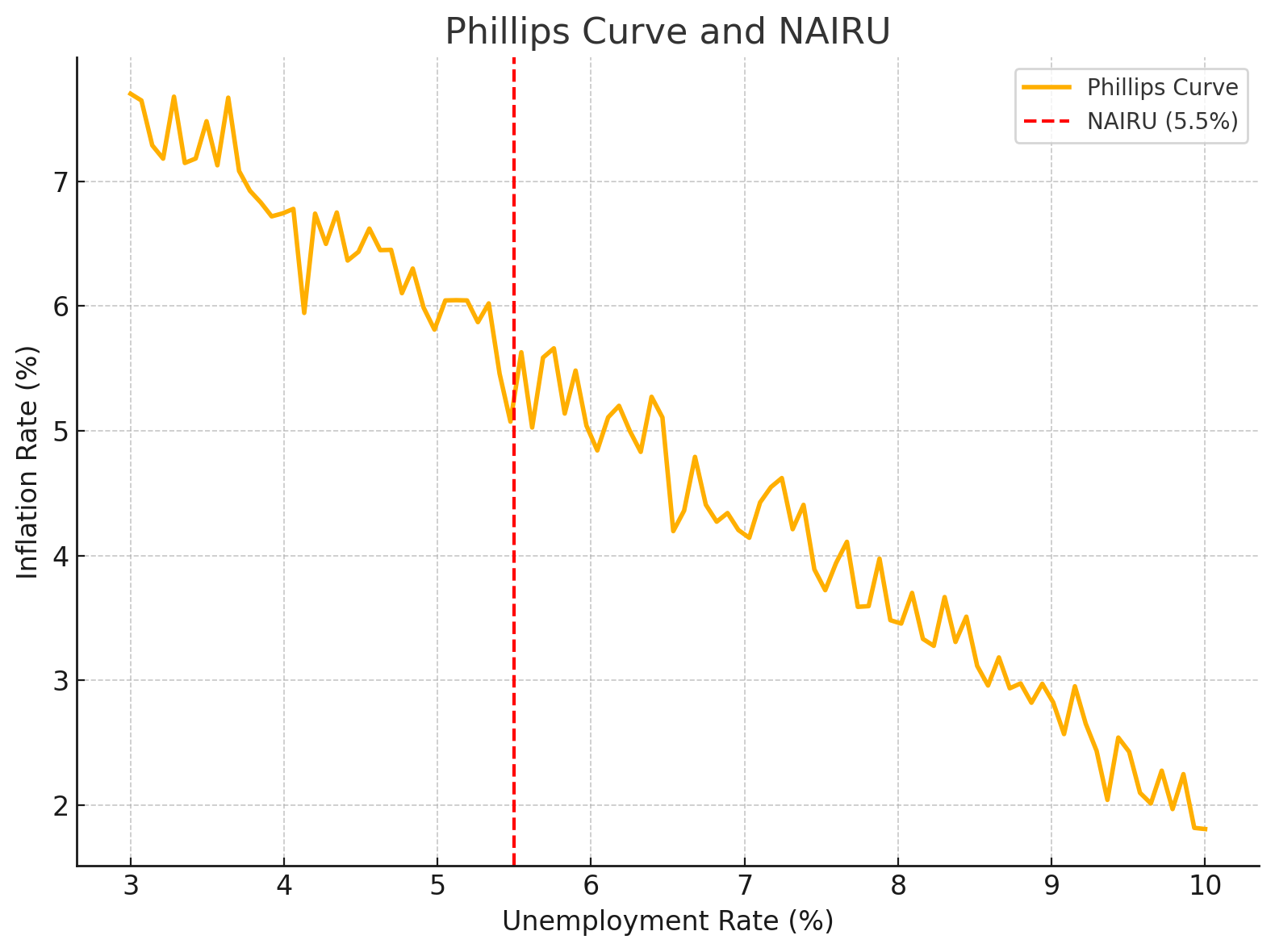
The concept of NAIRU is closely tied to the Phillips Curve, which illustrates a trade-off between unemployment and inflation. In the short run, lower unemployment may lead to higher inflation, and vice versa. NAIRU represents the point on the Phillips Curve where inflation is stable, and deviations from NAIRU cause inflation to accelerate or decelerate. However, the Phillips Curve relationship can weaken over time due to factors like anchored inflation expectations or global economic influences, making NAIRU harder to pinpoint.
Central banks, like the Reserve Bank of India (RBI) or the U.S. Federal Reserve, use NAIRU as a guide for monetary policy.
If unemployment falls below NAIRU and inflation rises, central banks may raise interest rates to cool the economy and prevent overheating.
If unemployment is above NAIRU and inflation is low, they may lower rates to stimulate growth and job creation.
However, misjudging NAIRU can lead to policy errors. For example, underestimating NAIRU might cause premature rate hikes, stifling growth, while overestimating it could lead to unchecked inflation.
Ask Anything, Know Better
January 12 DEFINITION In management and organizational behaviour, perception is the cognitive process through which individuals select, organize, and interpret sensory information from their environment to give meaning to people, events, situations, and objects in the workplace. It is not a passive reception of reality but a subjective, active process influenced by personal factors, leading to unique interpretations even when people face the same stimuli. As Stephen Robbins defines it: "Perception is the process by which individuals organize...
January 12 DEFINITON Organizational Behaviour (OB) is the systematic study of human behavior in organizational settings. It examines how individuals, groups, and structures interact within an organization, and how these interactions affect performance, satisfaction, culture, and overall effectiveness. OB integrates knowledge from psychology, sociology, anthropology, social psychology, and management to understand, predict, and influence behavior at work. As of 2026, OB remains highly relevant amid rapid changes like AI integration,...
January 12 DEFINITION Decision making is the process of selecting a course of action from multiple alternatives to achieve a desired outcome. It is fundamental in personal life, business, management, and leadership. Effective decision making involves a structured process, various techniques/tools, and established models that suit different contexts (time pressure, information availability, complexity, etc.). The Decision-Making Process Most sources describe a similar structured sequence, often with 6–8...
January 12 What is Management by Objectives (MBO)? Management by Objectives (MBO) is a results-oriented management system where organizational goals are translated into specific, measurable objectives, jointly set by managers and subordinates, and performance is evaluated against these objectives. The core idea behind MBO is that “People perform better when they clearly know what is expected from them and are involved in setting those expectations.” Thinker & Origin The concept was popularized by...
November 19
October 11 Overview Foreign Direct Investment, or FDI, happens when a company or person from one country puts money into a business in another country. This could mean building a new factory, buying a local company, or starting a joint venture. FDI can bring good things like new jobs, better technology, and more money for the host country. But it also comes with risks for both the investor and the country receiving the investment. In this article, we will look at these risks in simple terms. We will cover risks for the , risks for the...
September 15 Meaning of Monetization Turning something into money or turning non-revenue assets (e.g., free services) into profitable ones. For instance, in the music industry, artists monetize through streaming royalties or ad placements on platforms. Monetization refers to the process of converting something non-monetary—such as assets, data, services, or ideas—into money or revenue. In essence, it involves transforming resources that do not generate income into profit-generating opportunities. This can occur in...
September 12 What is Inflation? Inflation is a sustained increase in the general price level of goods and services in an economy over time, which erodes the purchasing power of money, meaning that each unit of currency buys fewer goods and services than before. It is not a one-time price hike but a persistent trend, often expressed as an annual percentage rate. Inflation is when a commodity you buy now comes for higher prices than the previous price for the same quantity and quality. While moderate inflation (around 2-3%) is considered...
September 12 Introduction The Gadgil formula, also known as the Gadgil-Mukherjee formula in its later modified form, is a criterion-based method developed in India for allocating central government assistance to states for their development plans. It was introduced to ensure a more equitable and objective distribution of funds, addressing imbalances where states bear significant responsibilities (like education and health) but have limited revenue sources, making them reliant on central transfers under Article 282 of the Indian...
September 05 Public Debt Public debt, also known as government debt or national debt, refers to the total accumulated amount of money that a government owes to creditors at a given point in time. It is a stock concept, meaning it represents the outstanding liabilities from past borrowings. Public debt arises when governments borrow funds (e.g., through bonds, loans, or treasury bills) to finance expenditures that exceed their revenues over multiple years. It includes both internal debt (owed to domestic lenders) and external debt (owed to...
Comments
Write Comment