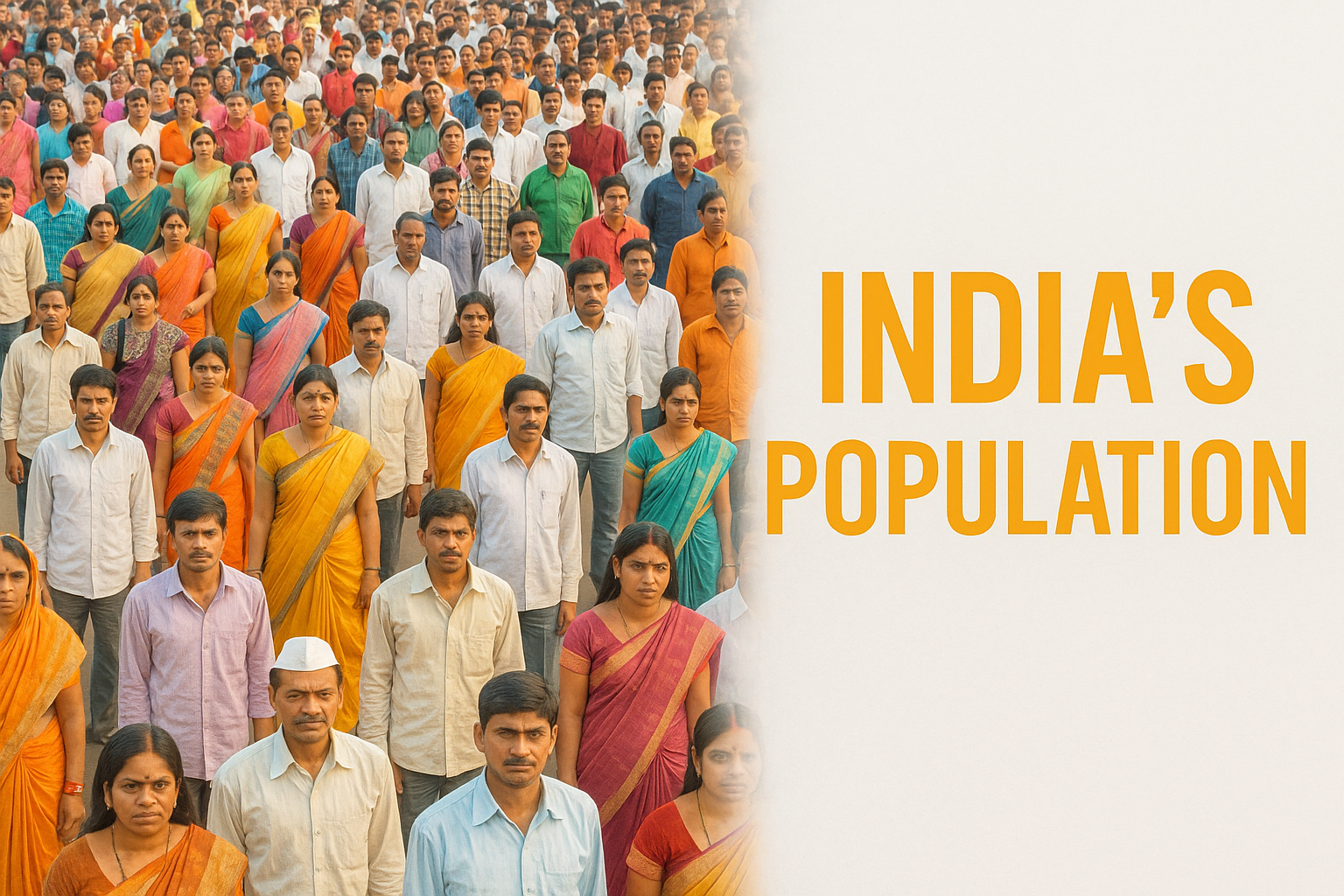
National Affairs
Main points of UN report (2025) on Population of India
WHAT?
The United Nations Population Fund (UNFPA) has released the State of World Population Report 2025 titled “The Real Fertility Crisis” and the India Ageing Report 2023.
It contains insights about size of India's population, it's birth rates, India’s demographic trends, fertility, ageing, reproductive health and many other aspects. Below is a concise summary of key insights from these reports.
KEY HIGHLIGHTS
- India Population Size: India’s population is estimated at 146.39 crore (1.46 billion) in April 2025, making it the world’s most populous country, surpassing China (141.61 crore). The population is projected to peak at around 170 crore in the early 2060s before gradually declining.
- Total Fertility Rate (TFR): India’s TFR has declined to 1.9 births per woman, below the replacement level of 2.1, indicating a demographic transition toward population stabilization. What is TFR? Click here to know. This drop is attributed to improved education, access to reproductive healthcare, and economic pressures. However, regional variations exist, with higher TFRs in states like Bihar (2.98), Meghalaya (2.9), Uttar Pradesh (2.35), Jharkhand (2.26), and Manipur (2.2).
- Reproductive Challenges: The report emphasizes that the real crisis is not overpopulation or underpopulation but the inability of individuals to achieve their fertility goals. About 36% of adult Indians face unintended pregnancies, and 30% experience unfulfilled desires for having more or fewer children, with 23% facing both issues. Financial constraints (38%), job insecurity (21%), housing issues (22%), and lack of childcare (18%) are major barriers.
- Life Expectancy: As of 2025, life expectancy is projected at 71 years for men and 74 years for women, reflecting improvements in healthcare.
- Demographic Dividend: India’s population includes 68% in the working-age group (15–64 years), offering a potential demographic dividend if supported by employment and policy measures. The youth population (10–24 years) constitutes 26%, while the elderly (65+) make up 7%, expected to rise in the coming decades.
- Reproductive Agency: The report advocates for greater reproductive autonomy, emphasizing access to contraception, safe abortion, maternal health, and infertility care. It calls for removing structural barriers (e.g., childcare, housing, job flexibility) and extending services to marginalized groups, including unmarried individuals and LGBTQIA+ communities.
- Regional Disparities: India exhibits a “high fertility and low fertility duality.” States like Bihar and Uttar Pradesh have higher fertility rates, while Kerala, Tamil Nadu, and Delhi have sustained below-replacement rates, reflecting disparities in education, healthcare, and economic opportunities.
- Elderly Population Growth: India’s elderly population (aged 60+) is growing rapidly at a decadal rate of 41%. By 2050, over 20% of the population will be elderly, surpassing the child population (0–15 years) by 2046. The 80+ population is projected to grow by 279% between 2022 and 2050, with a predominance of widowed and dependent women.
- Economic Challenges: Over 40% of the elderly are in the poorest wealth quintile, with 18.7% lacking income, impacting their quality of life and healthcare access.
- Gender and Regional Variations: Women have higher life expectancy at 60 (over 20 years in states like Rajasthan, Kerala, and Haryana), raising concerns about their social and economic well-being. The sex ratio among the elderly has increased since 1991, except in Union Territories and western India. Southern states like Kerala and Tamil Nadu have higher elderly populations than the national average, while Bihar and Uttar Pradesh lag.
SUGGESTIONS
The report suggests enhancing geriatric care, promoting in-situ (at-home) ageing with facilities like day-care, and addressing poverty and healthcare access for the elderly.Progress in India: India has reduced maternal mortality by 78% between 2000 and 2023, with maternal deaths now accounting for 8% of global fatalities. This progress is linked to better access to maternal health services and efforts to address gender discrimination. However, inequalities persist across states, castes, and income groups.
The report urges India to prioritize reproductive rights over population control, improve data on unmet family planning needs, promote gender equality, and foster community initiatives to challenge stigma and enhance health literacy.
ABOUT UNFPA
Established in 1969, UNFPA is the UN’s sexual and reproductive health agency, operating in over 150 countries. It focuses on ensuring wanted pregnancies, safe childbirth, and fulfilling young people’s potential. It is funded by voluntary contributions and reports to the UN Economic and Social Council (ECOSOC).
About author

Zinkpot — We Inform, You Perform.
Ask Anything, Know Better
अपना प्रश्न पूछें
-
Lucknow Becomes UNESCO Creative City of Gastronomy!
November 10 Context Lucknow, the capital city of Uttar Pradesh in India, has just been named a UNESCO Creative City of Gastronomy. This happened on October 31, 2025, which is World Cities Day. It's a big honor for the city known for its tasty food. Lucknow is now the second Indian city to get this title, after Hyderabad in 2019. The news has made people excited, including Prime Minister Narendra Modi, who congratulated the city. What is UNESCO's Creative Cities Network? UNESCO is a part of the United Nations that works on...
-
India’s Education Triumph: IITs and IISc Make It to Asia’s Top University List
November 05 Backgrond India is celebrating a big win in education! In the latest QS Asia University Rankings 2026, five Indian Institutes of Technology (IITs), the Indian Institute of Science (IISc), and Delhi University (DU) have made it into the top 100 universities in Asia. This shows how India's higher education is getting stronger and more recognized worldwide. In this article, we'll explain what these rankings are, India's performance, the top Indian schools, why this matters, and more! What Are the QS Asia University...
-
What is NITI Aayog Vision 2047?
October 14 Context NITI Aayog is India's top policy think tank that helps the government plan for growth and change. Its Vision 2047, also called Viksit Bharat @2047, is a big plan to turn India into a developed country by 2047, when India turns 100 years old as an independent nation. This vision focuses on making India strong in economy, society, environment, and governance. It aims for a huge economy worth $30-40 trillion, creating jobs, using new tech like AI, and including everyone in the progress. The plan was started a few...
-
What is a Census House?
September 15 CONTEXT As India prepares for its next decennial census, a seemingly simple term—“census house”—is taking center stage. This critical concept underpins how the government collects and analyzes data on housing and population, offering a window into how millions live across the nation. But what exactly is a census house, and why does it matter? Let’s dive into this cornerstone of population enumeration and explore its role in shaping India’s future. What is a Census...
-
What is India’s ULLAS Programme and FLNAT TEST?
September 15 ULLAS Programme The ULLAS (Understanding of Lifelong Learning for All in Society) programme, also known as the New India Literacy Programme (Nav Bharat Saaksharta Karyakram or NILP), is a centrally sponsored initiative by the Government of India under the Ministry of Education. Launched in April 2022, it aligns with the National Education Policy (NEP) 2020 and aims to promote lifelong learning, bridge literacy gaps, and empower non-literate adults aged 15 and above with foundational literacy, numeracy, and critical life...
-
How Luxury Goods are Harmful for a Nation?
August 25 WHAT Luxury goods like expensive cars, branded clothes, diamonds, and imported wines are seen as a status symbol in today’s world. They may give happiness and prestige to individuals, but at the national level, they create economic pressure, social inequality, and cultural harm. Key Points and Analysis Issue Analysis Result 1. Dependence on Imports Most luxury goods are imported, sending foreign exchange abroad. Money drains out instead of building...
-

Online Gaming Ban : Concepts and Concerns
August 22 CONTEXT For the past three and a half years, a major debate has been going on in the country – is online gaming, gambling or a skill-based game? Some states like Tamil Nadu, Andhra Pradesh, and Telangana banned these games, while courts argued that fantasy sports or rummy are skill-based and therefore cannot be considered pure gambling. Meanwhile, companies were making billions while millions of people were losing their life savings. Families saw their savings vanish, many fell into debt and several youngsters even took...
-
Why is AADHAR not a proof Citizenship?
August 14 WHAT? Aadhaar is India's unique 12-digit identification number issued by the Unique Identification Authority of India (UIDAI). It serves as a verifiable proof of identity and address for residents, but it is explicitly not a proof of citizenship. But why? WHY? There are many reasons for the same. One. Aadhaar is Issued to Residents, Not Exclusively to Citizens. Under the Aadhaar Act, 2016, eligibility is based on residency rather than nationality. Any individual who has resided in India for at least...
-
Brief on Poverty alleviation schemes in India
July 10 WHAT? Various Poverty alleviation schemes have been launched in India since Independence. Poverty alleviation requires an attempt to provide people with food, shelter, job and many other facilities to bring them out of deprivation. A summary is below. Employment Generation Schemes Scheme Year Key Features MGNREGA (Mahatma Gandhi National Rural Employment Guarantee Act) 2005 Guarantees 100 days of wage employment in rural areas; legal entitlement. Swarna...
-

All about the Rail One app!
July 02 WHAT? The RailOne app is a comprehensive, all-in-one mobile application launched by Indian Railways on July 1, 2025, designed to streamline passenger services into a single, user-friendly platform. Developed by the Centre for Railway Information Systems (CRIS), it consolidates functionalities previously spread across multiple apps like IRCTC Rail Connect, UTS, Rail Madad, and Food on Track, aiming to enhance convenience and reduce device storage needs. Key Features of the...
Comments
Write Comment