National Affairs
How Luxury Goods are Harmful for a Nation?
WHAT
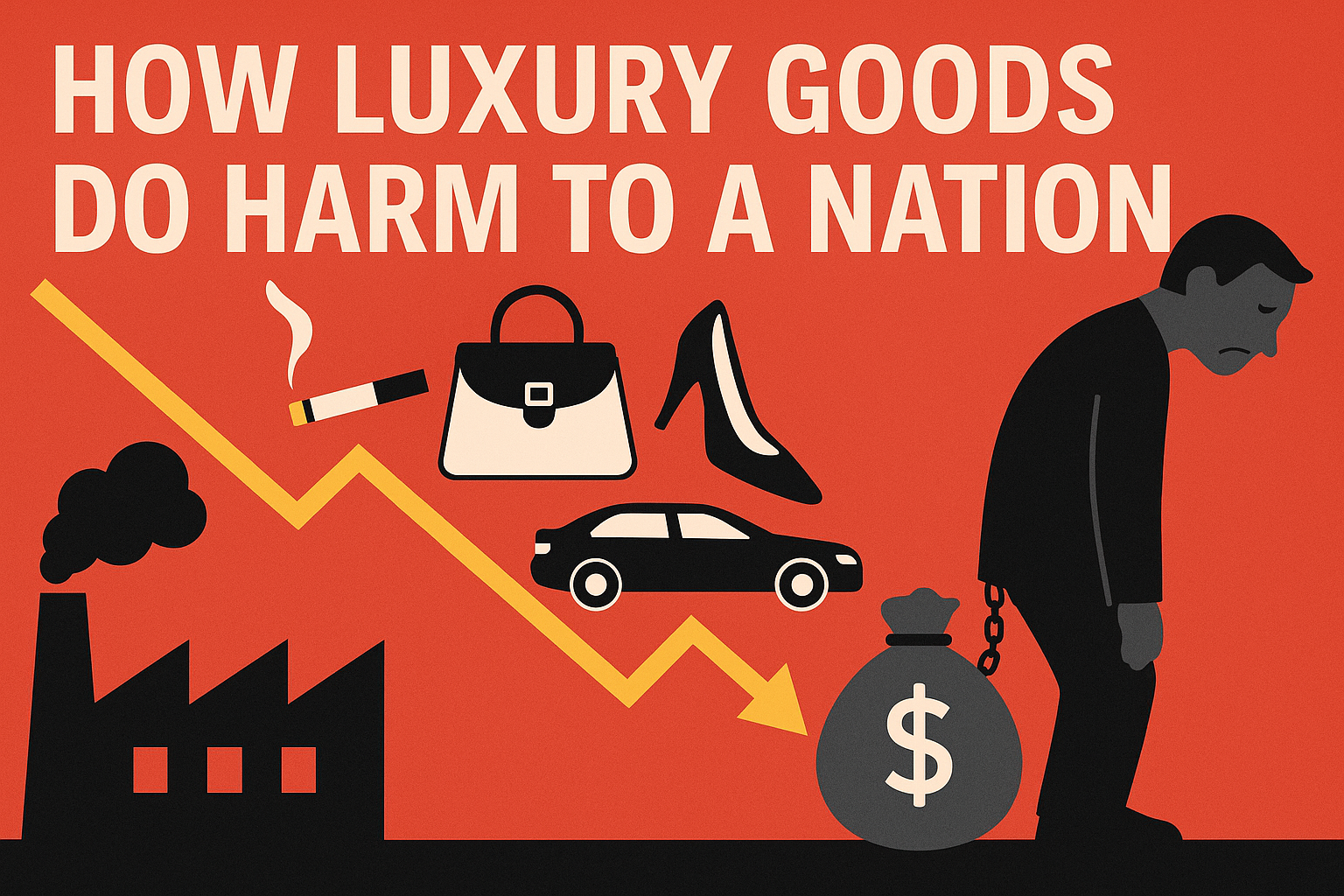
Luxury goods like expensive cars, branded clothes, diamonds, and imported wines are seen as a status symbol in today’s world. They may give happiness and prestige to individuals, but at the national level, they create economic pressure, social inequality, and cultural harm.
Key Points and Analysis
| Issue | Analysis | Result |
|---|---|---|
| 1. Dependence on Imports | Most luxury goods are imported, sending foreign exchange abroad. | Money drains out instead of building domestic industries, jobs, and infrastructure. |
| 2. High Taxes & Smuggling | Governments impose heavy taxes to curb luxury use. | Leads to smuggling, black markets, loss of government revenue, and more corruption. |
| 3. Show-off Culture | Luxury items are bought for social status; middle class copies via loans. | Widens rich-poor gap, increases frustration, and pushes families into debt. |
| 4. Damage to Local Industry | Preference for foreign brands reduces demand for local artisans/handloom. | Loss of traditional skills, decline in local employment, and erosion of cultural identity. |
Impacts
- Economic Impact: Outflow of foreign exchange, higher trade deficit, fewer jobs.
- Social Impact: Rich-poor gap, middle class stuck in debt, rising frustration.
- Moral Impact: Growth of materialism and consumerism.
- Policy Impact: More smuggling, black money, and corruption due to high taxes.
Luxury goods may bring happiness and pride to individuals, but for a nation they are mostly harmful. They drain wealth, increase inequality, and weaken local industries. The solution is to maintain a balance between need and show-off, and to promote local production and industries for long-term national growth.
About author

Zinkpot — We Inform, You Perform.
Ask Anything, Know Better
अपना प्रश्न पूछें
-
CBDT Exposes ₹9,169 Crore Fake Political Donation Scam Involving Small Parties, Accountants, and Middlemen
November 10 Overview India's tax department has caught a big scam where people used fake donations to political parties to avoid paying taxes. The Central Board of Direct Taxes (CBDT) found out about a ₹9,169 crore racket. This involved small political parties, accountants, and middlemen who helped cheat the system. The news came out on November 9, 2025, and it's a wake-up call for how some people misuse rules meant for real political funding. Why CBDT Monitors Donations CBDT is the government body that handles income...
-
Lucknow Becomes UNESCO Creative City of Gastronomy!
November 10 Context Lucknow, the capital city of Uttar Pradesh in India, has just been named a UNESCO Creative City of Gastronomy. This happened on October 31, 2025, which is World Cities Day. It's a big honor for the city known for its tasty food. Lucknow is now the second Indian city to get this title, after Hyderabad in 2019. The news has made people excited, including Prime Minister Narendra Modi, who congratulated the city. What is UNESCO's Creative Cities Network? UNESCO is a part of the United Nations that works on...
-
India’s Education Triumph: IITs and IISc Make It to Asia’s Top University List
November 05 Backgrond India is celebrating a big win in education! In the latest QS Asia University Rankings 2026, five Indian Institutes of Technology (IITs), the Indian Institute of Science (IISc), and Delhi University (DU) have made it into the top 100 universities in Asia. This shows how India's higher education is getting stronger and more recognized worldwide. In this article, we'll explain what these rankings are, India's performance, the top Indian schools, why this matters, and more! What Are the QS Asia University...
-
What is NITI Aayog Vision 2047?
October 14 Context NITI Aayog is India's top policy think tank that helps the government plan for growth and change. Its Vision 2047, also called Viksit Bharat @2047, is a big plan to turn India into a developed country by 2047, when India turns 100 years old as an independent nation. This vision focuses on making India strong in economy, society, environment, and governance. It aims for a huge economy worth $30-40 trillion, creating jobs, using new tech like AI, and including everyone in the progress. The plan was started a few...
-
What Got Cheaper and Costlier After GST Rate Cut 2025?
September 22 GST Rate Reforms 2025: Overview India's Goods and Services Tax (GST) underwent its most significant overhaul since 2017 with the rollout of "GST 2.0" reforms, approved by the 56th GST Council meeting on September 3, 2025. Effective from September 22, 2025 (coinciding with the start of Navratri), these changes simplify the structure from four main slabs (5%, 12%, 18%, 28%) plus cess to a streamlined system: 0% (exemptions), 5%, 18%, and a new 40% slab for luxury and "sin" goods. Tobacco products like...
-
What is a Census House?
September 15 CONTEXT As India prepares for its next decennial census, a seemingly simple term—“census house”—is taking center stage. This critical concept underpins how the government collects and analyzes data on housing and population, offering a window into how millions live across the nation. But what exactly is a census house, and why does it matter? Let’s dive into this cornerstone of population enumeration and explore its role in shaping India’s future. What is a Census...
-
What is India’s ULLAS Programme and FLNAT TEST?
September 15 ULLAS Programme The ULLAS (Understanding of Lifelong Learning for All in Society) programme, also known as the New India Literacy Programme (Nav Bharat Saaksharta Karyakram or NILP), is a centrally sponsored initiative by the Government of India under the Ministry of Education. Launched in April 2022, it aligns with the National Education Policy (NEP) 2020 and aims to promote lifelong learning, bridge literacy gaps, and empower non-literate adults aged 15 and above with foundational literacy, numeracy, and critical life...
-
NEXT GEN-GST REFORMS! What are the major changes made in GST 2.0 in 2025?
September 05 Category / Examples Old GST New GST Notes Consumer durables – air-conditioners, dishwashers, TVs (LCD/LED) 28% 18% Rate rationalisation for electronics. Cement 28% 18% Relief for housing & infra. Small cars (≤1200cc petrol/LPG/CNG ≤4000 mm; ≤1500cc diesel ≤4000 mm) 28% 18% Relief for middle class Motorcycles ≤350 cc 28% 18% >350 cc moved to 40%. Three-wheelers (HSN...
-
How GST council's voting and decision takes place?
September 05 The GST Council is established under Article 279A, introduced by the 101st Constitutional Amendment Act, 2016. It functions as a joint forum for decision-making between the Union and the States. Members of GST council include: Union Finance Minister (Chairperson) Union Minister of State in charge of Revenue/Finance State Finance Ministers or their nominees Weighted Voting Structure Decisions are made through a weighted voting system, structured as follows: Central Government holds 1/3 (≈33.33%) of...
-
What GST reforms may include?
September 03 The GST Council, led by Finance Minister Nirmala Sitharaman, is advancing an extensive overhaul of the Goods and Services Tax system—arguably the most significant since its launch in 2017. Key highlights include Elimination of 12% and 28% slabs: These are being phased out in favor of a two-rate structure—5% for essential and "merit" goods and 18% for standard items. A 40% "sin and luxury" rate will initially remain for high-value goods like tobacco and premium automobiles. Benefits...
- 1 RBI Digital Rupee e₹ क्या है? बिना Internet पेमेंट! कैसे इस्तेमाल करें Digital Rupee vs UPI April 15
- 2 About Trade Policy Uncertainty (TPU) Index and Global Economic Policy Uncertainty (GEPU) Index April 08
- 3 What is Food Credit and Non Food Credit? April 08
- 4 SARFAESI Act, 2002 Vs Insolvency & Bankruptcy Code (IBC), 2016 : Main Differences April 08
- 5 IN Skip navigation Search Sign in Transgender Bill 2026: क्या अब डॉक्टर तय करेंगे आपकी पहचान? NALSA से अब तक पूरा मामला April 01
- 6 80 लाख लोग सड़कों पर March 31
- 7 Iran US War: Strait of Hormuz के बाद Bab al-Mandeb Strait बंद हुआ तो दुनिया रोएगी | Zinkpot March 28
- 8 LPG vs CNG vs PNG | कौन सी गैस सबसे SAFE? Gas Crisis | Iran War | Zinkpot March 27
- 9 IPL 2026 सबसे बड़ा महामुकाबला । Maximum Teams, Prizes and Matches l Zinkpot March 26
- 10 Iran War 2026: ट्रंप की 48 घंटे की डेडलाइन खत्म… अब क्या होगा? March 25
- 11 USA LOST Dubai Trust? | Dubai अब Safe नहीं? | Iran War | ZINKPOT March 25
- 12 “मैं जिंदा हूं” – Netanyahu | Iran Nuclear Power खत्म? | IRAN War Update March 21
- 13 Iran war: Larijani killing Revenge | Iran Bombards Saudi Oil Refineries | Is this World War - 3 March 20
- 14 Israel–Iran Conflict Explained | क्या ये धर्म की लड़ाई है? | Middle East War Analysis March 19
- 15 IRAN WAR: TRUMP बेबस | Trump ने China से मांगी मदद | Strait of Hormuz संकट । Geopolitics March 17
- 16 Iran vs USA War: Operation Epic Fury पर उठे सवाल | Trump की बड़ी रणनीतिक गलती? March 16
- 17 IRAN WAR: Mojtaba Khamenei’s First Message | “हर मौत का बदला होगा” US-Israel को खुली चेतावनी March 14
- 18 IRAN WAR: जंग की लपटें रसोई तक | LPG CRISIS का संकट ! आख़िर कब तक March 13
- 19 IRAN WAR: AMERICA BLIND | क्या US Radar अब बेकार? March 12
- 20 What does Trump want from Iran? March 11
Comments
Write Comment