Basic concepts
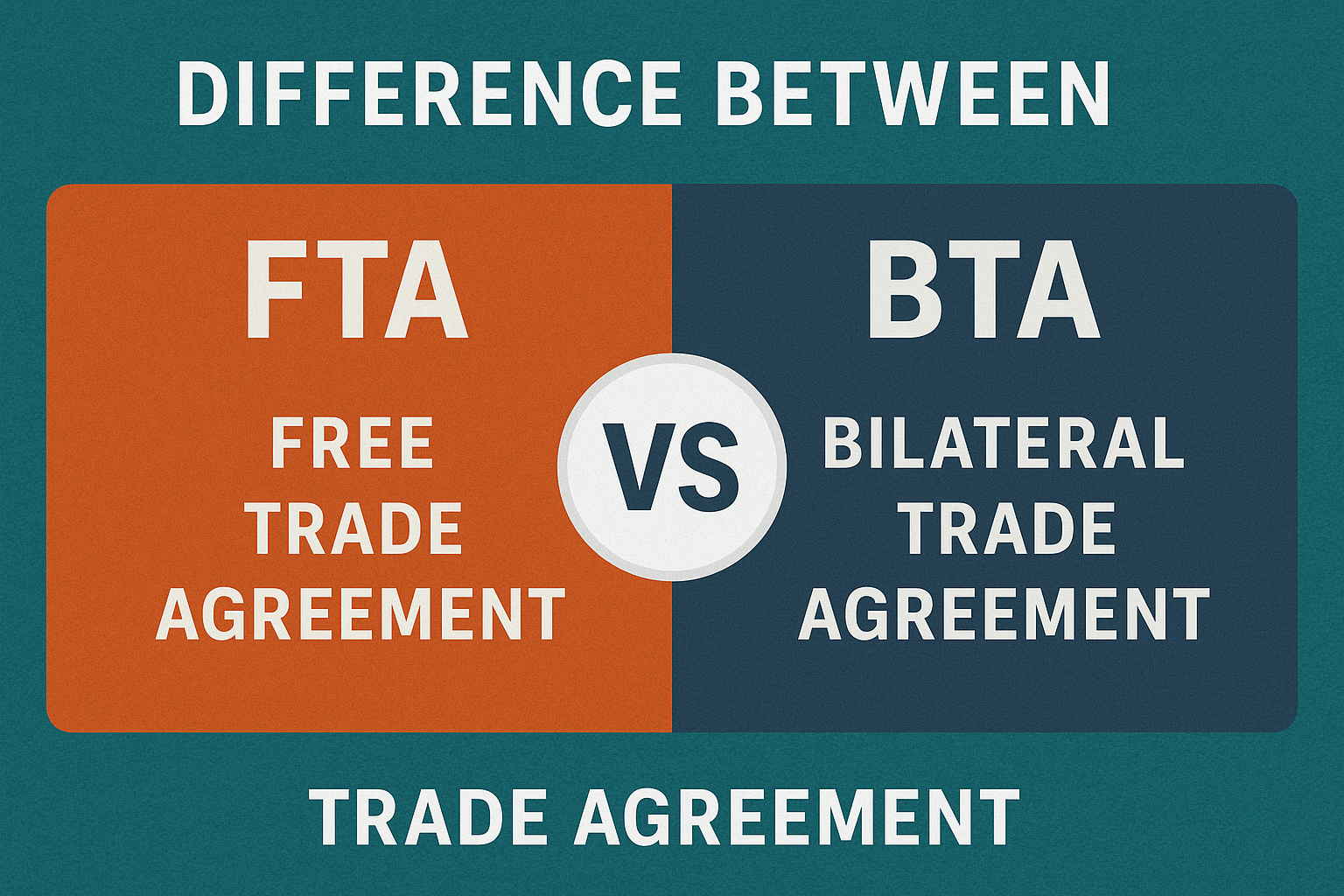
Difference between FTA and BTA in trade
WHAT?
The terms Free Trade Agreement (FTA) and Bilateral Trade Agreement (BTA) are often used in the context of international trade, but they have distinct meanings and implications. Below is a clear explanation of the differences based on their definitions, scope, and application.
Free Trade Agreement (FTA)
An FTA is a treaty between two or more countries to reduce or eliminate trade barriers, such as tariffs and quotas, to facilitate the free flow of goods and services. FTAs aim to create a free trade area where member countries trade with minimal restrictions while maintaining individual tariff structures for non-members. FTAs can be bilateral (between two countries) or multilateral (involving three or more countries). Examples include the India-Australia Economic Cooperation and Trade Agreement (IndAus ECTA) and the ASEAN-Australia-New Zealand FTA.
Bilateral Trade Agreement (BTA)
A BTA is a broader term referring to any trade agreement between two countries (or entities, such as a country and a trade bloc). It may include FTAs but can also encompass other types of agreements, such as Preferential Trade Agreements (PTAs), Comprehensive Economic Cooperation Agreements (CECAs), or Trade and Investment Framework Agreements (TIFAs). BTAs focus on promoting trade and investment by reducing barriers but may not always aim for the comprehensive tariff elimination seen in FTAs. An example is the proposed India-U.S. BTA currently under negotiation.
| Aspect | FTA | BTA |
|---|---|---|
| Definition | Agreement to create a free trade area with reduced/eliminated barriers. | Any trade agreement between two countries, including FTAs, PTAs, etc. |
| Scope | Comprehensive, covers “substantially all trade” (goods, services, etc.). | Can be narrow (specific sectors) or broad; less stringent than FTAs. |
| WTO Requirement | Must meet GATT Article XXIV (substantial trade coverage). | May not meet FTA criteria; must comply with other WTO provisions. |
| Examples | India-Australia ECTA, USMCA. | India-U.S. BTA (under negotiation), U.S.-Vietnam BTA. |
An FTA is a specific type of BTA that focuses on creating a free trade area by eliminating tariffs on most trade, adhering to strict WTO guidelines. A BTA is a broader term that includes FTAs but can also cover less comprehensive agreements like PTAs or CEPAs.
About author

Zinkpot — We Inform, You Perform.
Ask Anything, Know Better
अपना प्रश्न पूछें
-
What is meant by Perception in Management and Organizational behaviour?
January 12 DEFINITION In management and organizational behaviour, perception is the cognitive process through which individuals select, organize, and interpret sensory information from their environment to give meaning to people, events, situations, and objects in the workplace. It is not a passive reception of reality but a subjective, active process influenced by personal factors, leading to unique interpretations even when people face the same stimuli. As Stephen Robbins defines it: "Perception is the process by which individuals organize...
-
What is Organization Behaviour? Nature and Scope
January 12 DEFINITON Organizational Behaviour (OB) is the systematic study of human behavior in organizational settings. It examines how individuals, groups, and structures interact within an organization, and how these interactions affect performance, satisfaction, culture, and overall effectiveness. OB integrates knowledge from psychology, sociology, anthropology, social psychology, and management to understand, predict, and influence behavior at work. As of 2026, OB remains highly relevant amid rapid changes like AI integration,...
-
What is Decision making? Process, Techniques and Models
January 12 DEFINITION Decision making is the process of selecting a course of action from multiple alternatives to achieve a desired outcome. It is fundamental in personal life, business, management, and leadership. Effective decision making involves a structured process, various techniques/tools, and established models that suit different contexts (time pressure, information availability, complexity, etc.). The Decision-Making Process Most sources describe a similar structured sequence, often with 6–8...
-
What is Management by Objective (MBO)? Know it's Concept, application and Examples
January 12 What is Management by Objectives (MBO)? Management by Objectives (MBO) is a results-oriented management system where organizational goals are translated into specific, measurable objectives, jointly set by managers and subordinates, and performance is evaluated against these objectives. The core idea behind MBO is that “People perform better when they clearly know what is expected from them and are involved in setting those expectations.” Thinker & Origin The concept was popularized by...
-
All About the Risks of Foreign Direct Investment (FDI)
October 11 Overview Foreign Direct Investment, or FDI, happens when a company or person from one country puts money into a business in another country. This could mean building a new factory, buying a local company, or starting a joint venture. FDI can bring good things like new jobs, better technology, and more money for the host country. But it also comes with risks for both the investor and the country receiving the investment. In this article, we will look at these risks in simple terms. We will cover risks for the , risks for the...
-
Difference between Free Trade Agreements (FTA), PTA, CECA, CEPA and Bilateral Investment treaties (BIT)
October 07 BASIC DEFINITIONS Term Full Form What it Means Typical Depth of Market Access PTA Preferential Trade Agreement Two or more countries agree to reduce import duties on a limited number of products. Not a full free trade pact; tariffs are just partially lowered and only for some goods. Low — only certain tariff lines get concessions. FTA Free Trade Agreement Countries eliminate or reduce tariffs and quotas on most goods traded between them. Services and...
-
What is monetization and National Monetization Pipeline (NMP)?
September 15 Meaning of Monetization Turning something into money or turning non-revenue assets (e.g., free services) into profitable ones. For instance, in the music industry, artists monetize through streaming royalties or ad placements on platforms. Monetization refers to the process of converting something non-monetary—such as assets, data, services, or ideas—into money or revenue. In essence, it involves transforming resources that do not generate income into profit-generating opportunities. This can occur in...
-
Difference between inflation, deflation, disinflation, stagflation, skewflation, greedflation, shrinkflation
September 12 What is Inflation? Inflation is a sustained increase in the general price level of goods and services in an economy over time, which erodes the purchasing power of money, meaning that each unit of currency buys fewer goods and services than before. It is not a one-time price hike but a persistent trend, often expressed as an annual percentage rate. Inflation is when a commodity you buy now comes for higher prices than the previous price for the same quantity and quality. While moderate inflation (around 2-3%) is considered...
-
What is Gadgil formula?
September 12 Introduction The Gadgil formula, also known as the Gadgil-Mukherjee formula in its later modified form, is a criterion-based method developed in India for allocating central government assistance to states for their development plans. It was introduced to ensure a more equitable and objective distribution of funds, addressing imbalances where states bear significant responsibilities (like education and health) but have limited revenue sources, making them reliant on central transfers under Article 282 of the Indian...
-
What is the difference between Public debt and fiscal deficit?
September 05 Public Debt Public debt, also known as government debt or national debt, refers to the total accumulated amount of money that a government owes to creditors at a given point in time. It is a stock concept, meaning it represents the outstanding liabilities from past borrowings. Public debt arises when governments borrow funds (e.g., through bonds, loans, or treasury bills) to finance expenditures that exceed their revenues over multiple years. It includes both internal debt (owed to domestic lenders) and external debt (owed to...
- 1 RBI Digital Rupee e₹ क्या है? बिना Internet पेमेंट! कैसे इस्तेमाल करें Digital Rupee vs UPI April 15
- 2 About Trade Policy Uncertainty (TPU) Index and Global Economic Policy Uncertainty (GEPU) Index April 08
- 3 What is Food Credit and Non Food Credit? April 08
- 4 SARFAESI Act, 2002 Vs Insolvency & Bankruptcy Code (IBC), 2016 : Main Differences April 08
- 5 IN Skip navigation Search Sign in Transgender Bill 2026: क्या अब डॉक्टर तय करेंगे आपकी पहचान? NALSA से अब तक पूरा मामला April 01
- 6 80 लाख लोग सड़कों पर March 31
- 7 Iran US War: Strait of Hormuz के बाद Bab al-Mandeb Strait बंद हुआ तो दुनिया रोएगी | Zinkpot March 28
- 8 LPG vs CNG vs PNG | कौन सी गैस सबसे SAFE? Gas Crisis | Iran War | Zinkpot March 27
- 9 IPL 2026 सबसे बड़ा महामुकाबला । Maximum Teams, Prizes and Matches l Zinkpot March 26
- 10 Iran War 2026: ट्रंप की 48 घंटे की डेडलाइन खत्म… अब क्या होगा? March 25
- 11 USA LOST Dubai Trust? | Dubai अब Safe नहीं? | Iran War | ZINKPOT March 25
- 12 “मैं जिंदा हूं” – Netanyahu | Iran Nuclear Power खत्म? | IRAN War Update March 21
- 13 Iran war: Larijani killing Revenge | Iran Bombards Saudi Oil Refineries | Is this World War - 3 March 20
- 14 Israel–Iran Conflict Explained | क्या ये धर्म की लड़ाई है? | Middle East War Analysis March 19
- 15 IRAN WAR: TRUMP बेबस | Trump ने China से मांगी मदद | Strait of Hormuz संकट । Geopolitics March 17
- 16 Iran vs USA War: Operation Epic Fury पर उठे सवाल | Trump की बड़ी रणनीतिक गलती? March 16
- 17 IRAN WAR: Mojtaba Khamenei’s First Message | “हर मौत का बदला होगा” US-Israel को खुली चेतावनी March 14
- 18 IRAN WAR: जंग की लपटें रसोई तक | LPG CRISIS का संकट ! आख़िर कब तक March 13
- 19 IRAN WAR: AMERICA BLIND | क्या US Radar अब बेकार? March 12
- 20 What does Trump want from Iran? March 11
Comments
Write Comment