
Debt Market
What is a Fully Accessible Route (FAR) in G-Secs?
WHAT IS FAR?
The Fully Accessible Route (FAR) is a regulatory framework introduced by the Reserve Bank of India (RBI) and the Government of India in March 2020 to attract more foreign investment into Indian government securities (G-Secs).
KEY FEATURES
| Feature | Details |
|---|---|
| Purpose | To enable unrestricted access for Non-Resident Investors (FPIs) |
| Eligible Securities | Specific Government of India bonds are designated under FAR |
| Access Type | No investment ceiling or limit for foreign investors |
| Currency | Indian Rupee |
| Tenor | Usually applies to longer-term G-Secs (5, 10, 30 years, etc.) |
| Participants | Available to both foreign and domestic investors equally |
Why FAR Was Introduced?
-
To integrate India’s bond market with global financial markets.
-
To minimize entry restrictions in India's debt market and to increase foreign capital inflow into government securities.
- As part of efforts to include Indian G-Secs in global bond indices (like JPMorgan, Bloomberg-Barclays, FTSE).
Example
If the government issues a 10-year bond of ₹1,000 crore under FAR, Foreign investors can invest any amount without the usual FPI investment limits. Domestic investors can also buy it normally. No sectoral caps or regulatory ceilings apply under FAR.
Impact So Far
-
Helped attract foreign portfolio investment in Indian bonds.
-
Paved the way for India’s inclusion in JPMorgan Government Bond Index (starting 2024–25).
-
Added depth and liquidity to the bond market.
About author

Zinkpot — We Inform, You Perform.
Ask Anything, Know Better
अपना प्रश्न पूछें
-
RBI may approve 1-3% provisioning floor for stage-2 loans under ECL framework: Sources
November 17 BUSINESS LINE : The Reserve Bank of India could consider approving bankers’ request to lower the provisioning requirement on stage-2 loans to 1-3 per cent from proposed 5 per cent under the draft expected credit loss (ECL) guidelines, sources say. ABOUT ECL? CLICK HERE ABOUT PROVISIONING? CLICK HERE NEWS LINK
-
Upto 4 nominees? अब आपका पैसा किसे मिलेगा?
October 24
-
What are unclaimed deposits with Banks?
September 24 What Are Unclaimed Bank Deposits? Unclaimed deposits are balances lying in savings accounts, fixed deposits, recurring deposits, or other bank accounts that have had no customer activity for 10 years or more. After this period, banks are required to transfer these amounts to the Depositor Education and Awareness Fund (DEAF), maintained by the Reserve Bank of India (RBI). Importantly, these deposits are not forfeited. Depositors or their legal heirs can still claim the money at any time through the bank, which then seeks...
-
What is a Credit Default Swap (CDS)?
September 09 WHAT? A Credit Default Swap (CDS) is a type of financial derivative contract that acts like insurance against the default of a loan or bond. When an investor is concerned that a borrower (like a company or government) might default on its debt, the investor can buy a CDS from an institution e.g. a bank to protect itself. In return for a regular payment (called a premium), the seller of the CDS agrees to compensate the buyer of the CDS (the investor) if the borrower fails to repay. How Does a CDS...
-
What are State Development Loans (SDL)?
September 09 WHAT? State Development Loans (SDLs) are bonds issued by state governments in India to raise funds for their developmental needs. These are long-term borrowings intended to finance infrastructure, welfare schemes, and cover fiscal deficits. Since state revenue is often insufficient to meet expenditure demands, SDLs help bridge the funding gap in a structured and regulated manner. Although the SDLs are issued by state governments, the process is managed by the Reserve Bank of India (RBI), which conducts auctions on their behalf. These...
-
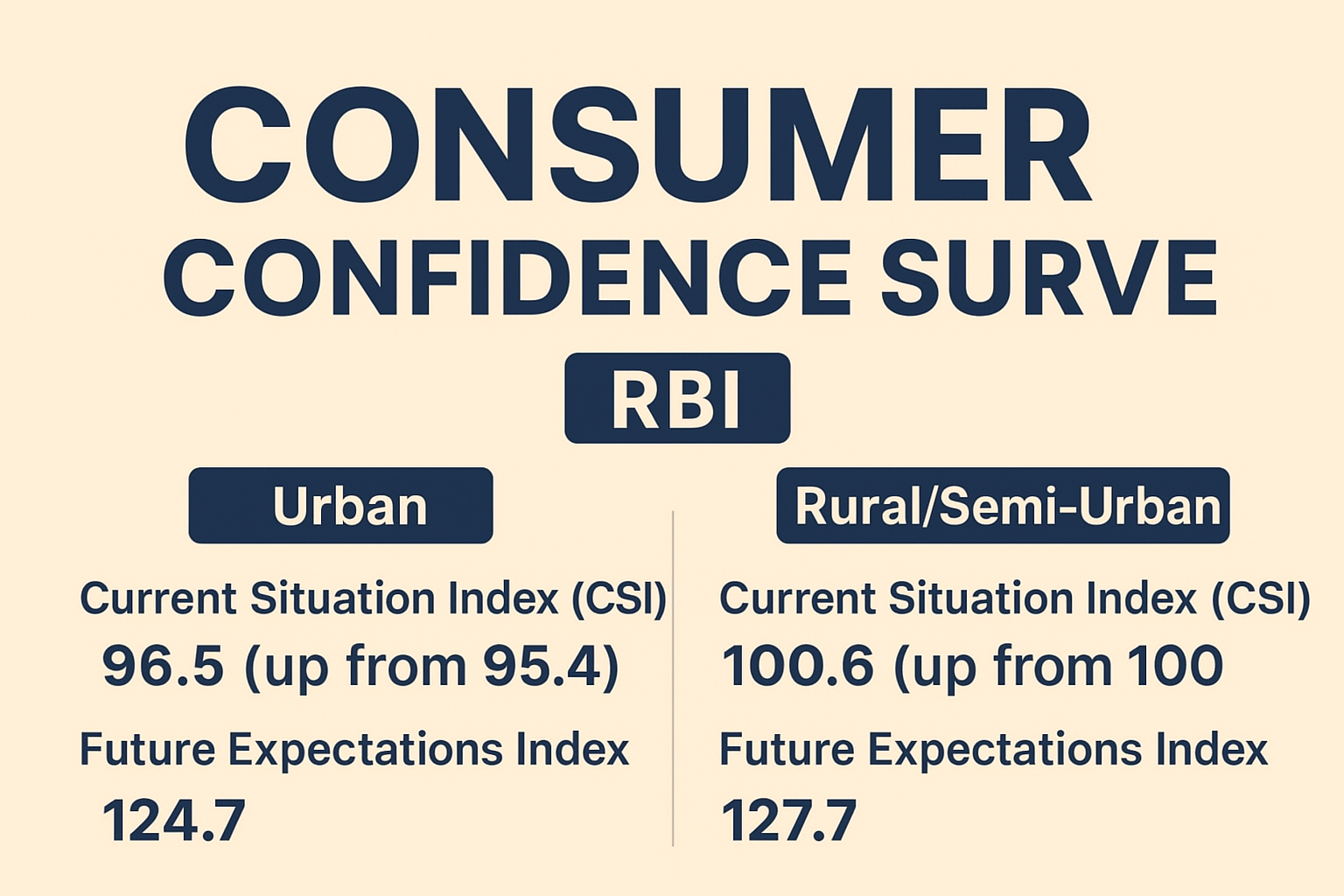
About RBI's Consumer Confidence Survey
August 29 WHAT? Consumer confidence is an economic indicator that gauges how optimistic or pessimistic consumers feel about the economy and their personal financial situation. RBI's Consumer Confidence Survey (CCS) is conducted bi-monthly. RBI’s CCS assesses perceptions and outlook on key economic parameters such as the general economic situation, employment, income, prices, and spending behavior. It produces two key indices: Current Situation Index (CSI) – Measures consumer sentiment about the...
-
What are 54EC Bonds?
August 29 WHAT? 54EC Bonds are a type of tax-saving bonds issued under Section 54EC of the Income Tax Act, 1961. The purpose is that if someone sells a long-term capital asset (like land, house, or building) and earns long-term capital gain (LTCG), they can invest the profit in these bonds and claim exemption from capital gains tax. Key Features of 54EC Bonds Who can invest : Individuals, HUFs, Companies, and Firms. Applicable only on long-term capital gains (not short-term). Eligible Bonds...
-

What are Dimsum Bonds?
August 24 WHAT? Dim sum bonds are a type of debt security issued outside of mainland China—primarily in Hong Kong—and denominated in Chinese renminbi (RMB, also known as yuan or CNY). They allow foreign investors to gain exposure to the RMB currency without directly accessing China's domestic bond market, which has historically been restricted to outsiders. The name "dim sum" is a playful reference to the popular bite-sized Chinese dishes often associated with Hong Kong cuisine, symbolizing the bonds'...
-
Cheques to clear within hours from October 4, says RBI
August 16 WHAT? The Reserve Bank of India (RBI) has announced a new mechanism to expedite cheque clearing, effective October 4, 2025, reducing the clearance time from the current T+1 days (up to two working days) to a few hours. The Cheque Truncation System (CTS) will transition from batch processing to continuous clearing with on-realisation-settlement, improving efficiency, reducing settlement risks, and enhancing customer experience. Implementation Phases Phase 1 (October 4, 2025 – January 2, 2026):...
-
What is RBI's Financial Inclusion Index (FI-Index)?
July 23 WHAT? The Reserve Bank of India (RBI) publishes the Financial Inclusion Index (FI-Index) annually to measure the extent of financial inclusion across India. Financial inclusion means including more and more people in the formal banking network. The FI-Index is a comprehensive metric that quantifies financial inclusion on a scale from 0 (complete financial exclusion) to 100 (full financial inclusion). It incorporates 97 indicators across banking, investments, insurance, postal, and pension sectors, developed in...
Comments
Write Comment