Inflation, Monetary Policy and RBI
What are unclaimed deposits with Banks?
What Are Unclaimed Bank Deposits?
Unclaimed deposits are balances lying in savings accounts, fixed deposits, recurring deposits, or other bank accounts that have had no customer activity for 10 years or more. After this period, banks are required to transfer these amounts to the Depositor Education and Awareness Fund (DEAF), maintained by the Reserve Bank of India (RBI).
Importantly, these deposits are not forfeited. Depositors or their legal heirs can still claim the money at any time through the bank, which then seeks reimbursement from RBI.
Conditions for Classifying Deposits as “Unclaimed”
As per RBI rules, an account becomes unclaimed if:
- No activity for 10 years – No withdrawals, deposits, cheque issuance, fund transfers, or ATM use by the customer. (Note: Interest credited by the bank does not count as activity.)
- Matured Fixed Deposits not withdrawn – If maturity proceeds remain unclaimed for 10 years after the due date.
- Recurring / Term Deposits – Similar rule applies if the maturity amount is not claimed for 10 years.
- No customer contact – If the bank receives no communication from the customer for 10 years.
- Joint Accounts – If one holder dies and the survivor doesn’t operate the account, it may become unclaimed after 10 years.
The amount of Unclaimed Deposits
As of 2025, unclaimed deposits stood at around ₹67,270 crore (Moneycontrol). In June 2025, the figure was ₹67,003 crore, with the State Bank of India (SBI) alone holding 29% of these funds (The Indian Express).
In March 2024, RBI data showed unclaimed balances at ₹78,213 crore, highlighting the rapid increase. Depending on the cut-off dates and definitions, the total is currently estimated at ₹60,000 to ₹80,000+ crore.
Why Do Deposits Become Unclaimed?
Several factors contribute to deposits going unclaimed:
- Death of Account Holder – If the account holder passes away without a nominee, or heirs are unaware of the account.
- No Nominee / KYC Issues – Missing or incomplete nomination and documentation delays claims.
- Forgotten Accounts – Dormant salary or savings accounts left idle after job changes, relocation, or migration abroad.
- Senior Citizens’ Deposits – Long-tenure fixed deposits that are forgotten after maturity.
- Mergers & Branch Closures – Bank mergers or branch closures lead to tracking issues.
- Litigation & Family Disputes – Accounts stuck in inheritance disputes.
- Lack of Awareness / Access – Low financial literacy and poor communication prevent claims, especially in rural areas.
- Corporate Accounts – Defunct companies often leave balances in old current accounts.
What Does RBI Do With DEAF?
The Depositor Education and Awareness Fund (DEAF), created in 2014 under Section 26A of the Banking Regulation Act, holds all such balances. As of 2025, DEAF contains over ₹60,000 crore.
RBI uses the fund as follows:
- Depositor Education – Running awareness campaigns on safe banking, fraud prevention, nomination, and financial literacy.
- Claims Settlement – When a depositor or heir approaches the bank with valid proof, the bank refunds the money and gets reimbursed from DEAF.
- Research & Awareness Promotion – Supporting research, training, and awareness on depositor protection.
- Investment of Funds – RBI invests the fund safely. The interest earned is used for education and awareness activities, while the principal remains intact to honor future claims.
The rise in unclaimed deposits points to gaps in financial awareness, nomination practices, and inheritance planning. Regularly updating nominees, keeping track of fixed deposits, and ensuring family members know about accounts can prevent money from lying idle in DEAF.
About author

Zinkpot — We Inform, You Perform.
Ask Anything, Know Better
अपना प्रश्न पूछें
-
What is Food Credit and Non Food Credit?
April 08 What is Non food credit? Non-Food Credit is used to measure how much bank lending is going to sectors other than government food procurement operations. It is an important indicator of real economic activity and private sector demand for loans. Non-Food Credit : Non-Food Credit = Total bank credit – Food credit It refers to loans given by banks to sectors like: Industry Services Agriculture Retail / Personal loans MSMEs Infrastructure Trade and commerce Non-Food...
-
Is the Dollar’s Dominance Coming to an End?
November 19 What does the Dollar Dominance Mean? For nearly eight decades, the U.S. dollar (USD) has been the world’s reserve currency and has been used for Global trade and oil payments (the “petrodollar” system) Central bank reserves International loans and debt Safe-haven investment in crises The dollar has been the backbone of the global financial system. About 58–60% of all global foreign exchange reserves are still held in dollars (IMF, 2025). How did the Dollar become...
-
RBI may approve 1-3% provisioning floor for stage-2 loans under ECL framework: Sources
November 17 BUSINESS LINE : The Reserve Bank of India could consider approving bankers’ request to lower the provisioning requirement on stage-2 loans to 1-3 per cent from proposed 5 per cent under the draft expected credit loss (ECL) guidelines, sources say. ABOUT ECL? CLICK HERE ABOUT PROVISIONING? CLICK HERE NEWS LINK
-
FREE Credit Card का सच!
October 25
-
Upto 4 nominees? अब आपका पैसा किसे मिलेगा?
October 24
-
What is Deposit Insurance? No worries on bank collapse!
October 10
-
Nepal, Bhutan and Srilanka to get loans in INR? Rupee going international?
October 03 What RBI Is Allowing? As of October 2025, RBI has decided that Authorised Dealer (AD) banks in India and their overseas branches can extend rupee-denominated loans to residents and institutions in Bhutan, Nepal, and Sri Lanka for trade-related transactions. Reserve Bank of India (RBI) has moved to allow loans in Indian rupees (INR) to neighbouring countries under certain conditions. This is part of a broader push to internationalize the rupee and deepen rupee-based trade and finance. The measure aims to facilitate...
-
RBI’s Bold Banking Reforms: Easier Loans, Stronger Banks, Global Rupee Push
October 03 What? In a landmark announcement that signals a new era for India's financial sector, the Reserve Bank of India (RBI) has unveiled a comprehensive package of banking reforms designed to simplify lending, fortify institutional resilience, and accelerate the internationalization of the Indian rupee. Described by experts as a "bold and forward-looking" overhaul, these measures come on the heels of the Monetary Policy Committee's (MPC) decision to maintain the repo rate at 6.50%, while shifting to a...
-
Why is FSDC a guardian of India's financial health?
September 08 WHAT? The 2008 Global Financial Crisis exposed how fragmented regulation in banking, insurance, and capital markets can destabilize entire economies. Learning from this, the Government of India established the Financial Stability and Development Council (FSDC) in December 2010 to strengthen financial resilience and protect the economy from systemic shocks. The FSDC is a high-level, non-statutory body that brings all key financial regulators under one platform. In today’s era of global uncertainty—marked by...
-
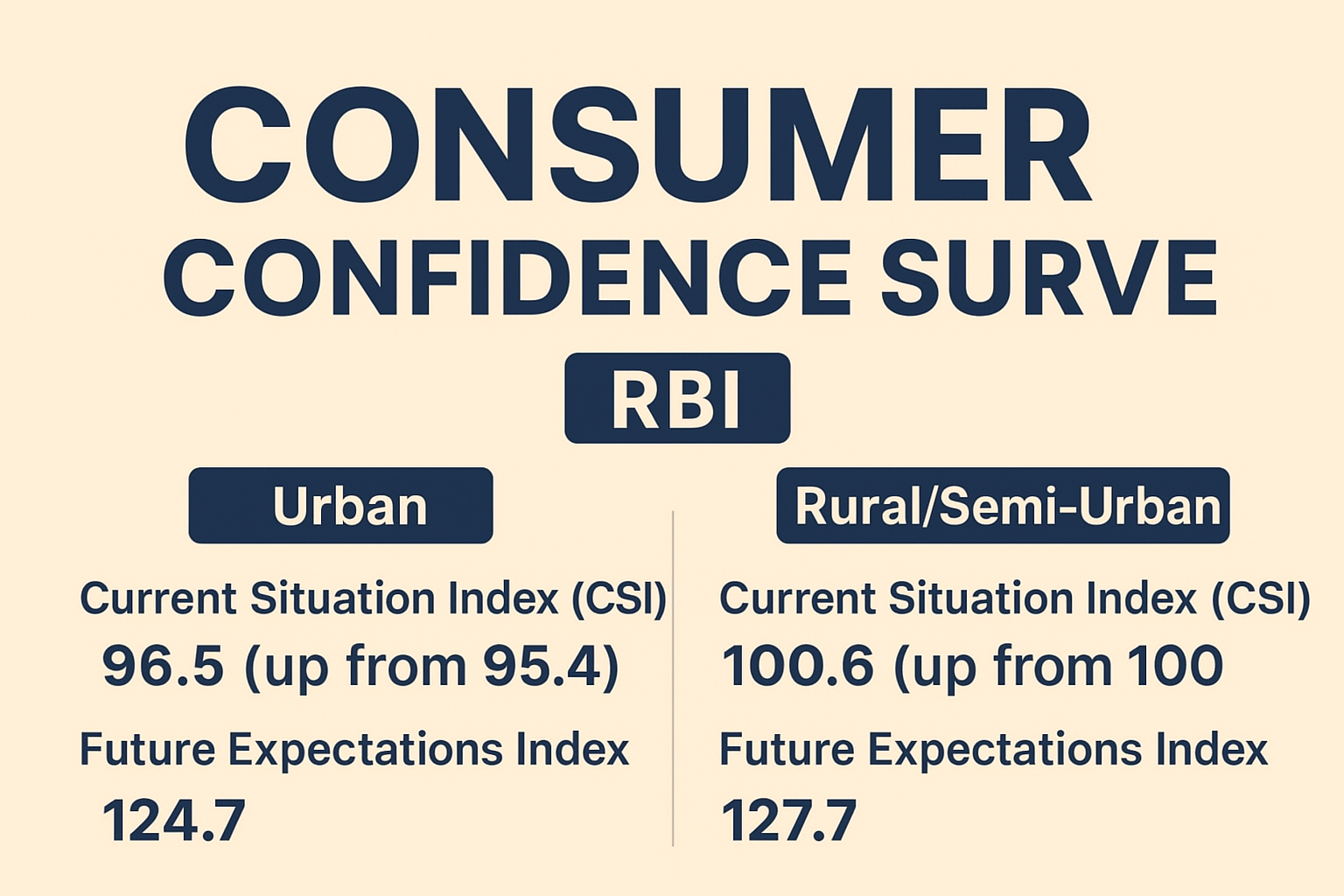
About RBI's Consumer Confidence Survey
August 29 WHAT? Consumer confidence is an economic indicator that gauges how optimistic or pessimistic consumers feel about the economy and their personal financial situation. RBI's Consumer Confidence Survey (CCS) is conducted bi-monthly. RBI’s CCS assesses perceptions and outlook on key economic parameters such as the general economic situation, employment, income, prices, and spending behavior. It produces two key indices: Current Situation Index (CSI) – Measures consumer sentiment about the...
Comments
Write Comment